
Red Flags in Perfume Batch Records and Factory Quality Control
A weak quality system does not usually fail loudly. It produces records that look complete, certificates that look impressive and answers that sound confident. The tell is rarely in what a factory says and almost always in small inconsistencies: timestamps that do not match the batch, a reference sample nobody can locate, a restriction statement that describes a library rather than a formula. These are the signals worth acting on before a purchase order is signed.
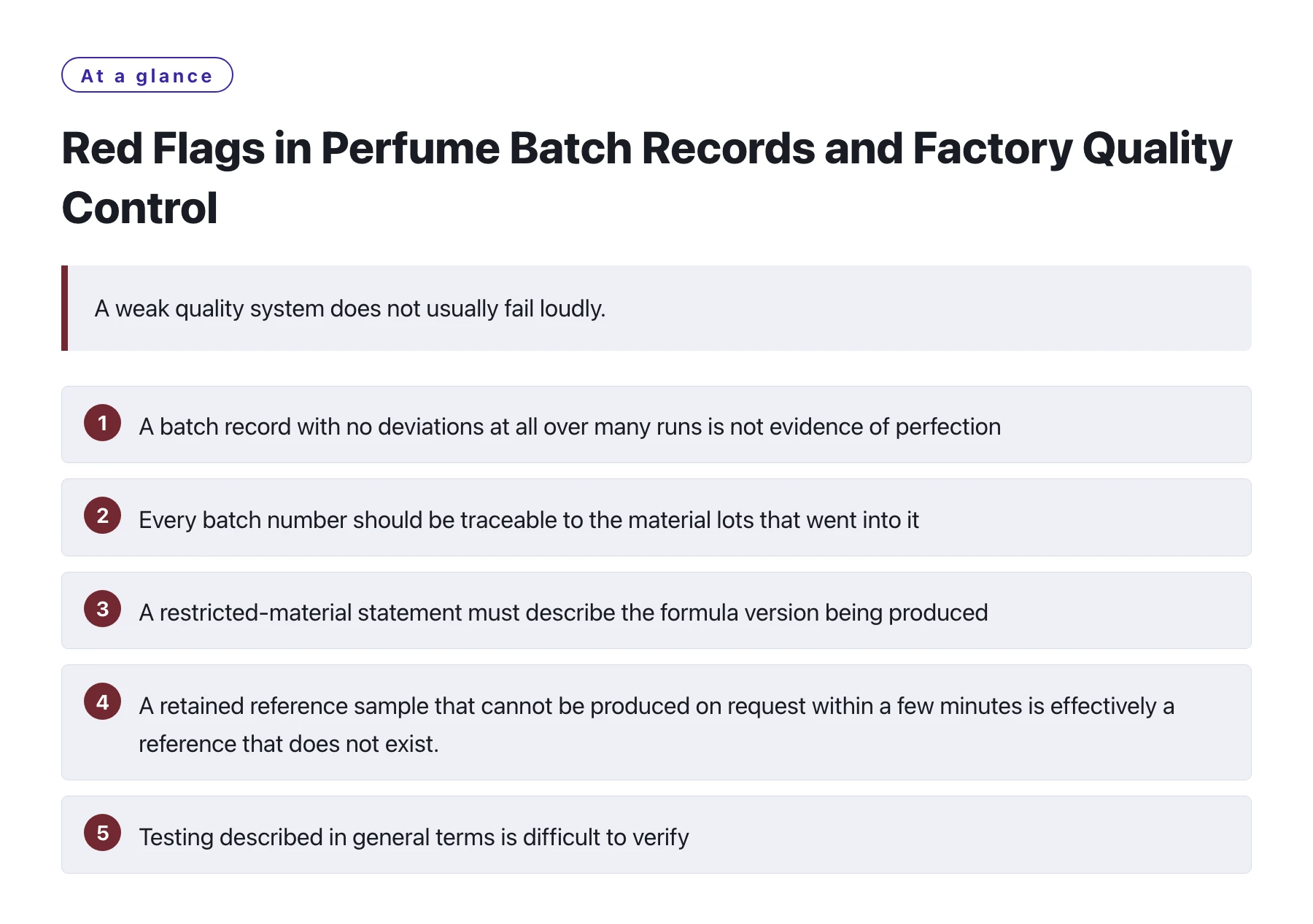
Key takeawaysA batch record with no deviations at all over many runs is not evidence of perfection; it is more often evidence that deviations are not being written down. · Every batch number should be traceable to the material lots that went into it, because without that link a supplier cannot narrow a problem to one delivery. · A restricted-material statement must describe the formula version being produced, since limits depend on the product category and the dosage [3]. · A retained reference sample that cannot be produced on request within a few minutes is effectively a reference that does not exist. · Testing described in general terms is difficult to verify, while named test scopes from an independent laboratory can be checked against published services [1].
Due diligence on a fragrance supplier tends to focus on the tour: the compounding vessels, the filling line, the decoration area. Those matter, but the more revealing material is a paper folder. Ask to see the batch record for a recent run and the behaviour around it tells you a great deal — whether the file is found immediately, whether the person explaining it was involved in the run, and whether the entries look like they were made while the work happened.
The list below collects the warning signs that experienced buyers mention most often. None of them is proof of a bad factory on its own. Each is a reason to ask the next question, and several of them together describe a system that exists mainly for show.
It is written with a creator-led launch in mind, because the consequence of a quality failure is different when the product has an audience. A batch that drifts is not only a commercial problem; it is content, and it travels.
Red flags in the records themselves
Records are the cheapest thing a factory can produce and the hardest thing to fake consistently. Four signals recur.
Entries written in one sitting. If a compounding record for an eight-hour batch has every timestamp within twenty minutes, or the ink, handwriting and pressure are identical from start to finish, the record was written afterwards. That does not automatically mean the batch was wrong, but it does mean the record cannot be used as evidence of what happened.
No deviations, ever. Real production produces deviations: a mixing time that ran long, a weighing that was corrected, a pump that needed replacing. A file with none of them across a dozen batches is a file that has been normalised rather than a factory that has never had a problem.
Batch numbers with no lot trail. The batch number should lead back to which delivery of each material was used. Where that link is missing, a supplier cannot answer the only question that matters during a material issue: which of my products are affected [2].
Certificates used as substitutes. A certificate of analysis reports tests, and a quality certificate reports a system audit. Neither replaces a batch record, and a supplier that offers one in place of the other is describing a thinner system than the order requires.
The retention test
Ask to see the retained reference sample for a batch produced six months ago. A well-run factory will find it, sealed, labelled with the batch number and stored under controlled conditions. A factory that cannot produce it is telling you that reorder consistency will be judged by memory.
Retention is not an expensive habit, which is why the failure to keep references is informative. It suggests that the process is organised around the current order rather than around the product's life.
Statements that describe the wrong object
A restriction and allergen statement should be specific to the formula version and the product category being made. Statements that describe a fragrance family, or that are copied from a library entry without a version reference, cannot be checked against what is actually in the tank.
This is a common and mostly innocent error in factories that produce many library scents, but it becomes serious when a brand needs to demonstrate the position to a retailer or a marketplace. The published standards that set out use limits are revised over time, so the version matters as much as the statement [3].
Red flags in the organisation around the records
Some signals are not on paper at all.
Quality reporting into production. If the person who can stop a batch reports to the person whose schedule slips when a batch stops, the gate is structurally weak. This is common in smaller plants, and it can be managed, but it should be visible rather than assumed away.
Answers that change between visits. A question about testing that is answered one way by sales and another way by the technical team is worth following up. Independent laboratories publish the cosmetics testing scopes they provide, which makes it possible to check whether a described programme matches services that exist [1].
Reluctance to be specific about who signs what. Release authority is a simple question with a simple answer in a mature system. Vagueness here usually means the process is personal rather than documented.
Willingness to skip a step to make a date. This is the most important one, and it is best tested with a small request during a scheduled conversation: ask what happens if a delivery arrives without full documentation on the day the line is ready. A factory that describes a hold procedure is describing a system. A factory that describes a favour is describing a habit.
The red flag that is really a green flag
One behaviour inverts the whole list. A factory that volunteers a problem — a batch that drifted, a delivery that failed intake, a decoration run that was scrapped — is showing that its gates work. Buyers consistently report that this is the single most reassuring thing a supplier can do, because it means failures are being caught internally rather than discovered by customers.
For a creator launch, that conversation is worth having early. Ask a prospective partner to describe the last run it rejected and why. The answer says more about the quality system than any certificate.
How this reads differently for a Chinese contract manufacturer
None of these signals is specific to a country, but they can present differently when the buyer is not on site. In a remote relationship, the documents are the relationship, which raises the value of a complete batch file and lowers the value of a plant tour. Buyers working with contract perfume manufacturing in China should ask for the file as a matter of routine from the first run, so that the habit is established before volume arrives.
It also helps to understand the sequence of a run before auditing it. A walkthrough of the perfume production process gives a buyer the vocabulary to ask where in that sequence a specific check happens, which turns a general question about quality into a specific one about a gate.
If a shortlist has to be reduced to one question, ask each candidate to send the batch record and the retained reference photograph for a run completed in the previous quarter. Factories with a working system will send both quickly and without being asked twice. That response, rather than anything said during a meeting, is the most reliable indicator of how the factory behind these scents — or any other candidate — will behave when something goes wrong in your own run.
Sources
- SGS: Cosmetics, Personal Care & Household Testing —— Testing, inspection and certification services for cosmetics and personal care, including microbiological, stability and safety testing aligned with cosmetics GMP.
- Cosmetics & Toiletries —— A technical magazine for cosmetic formulators, covering ingredients, formulation science and testing methods.
- IFRA Standards Library (International Fragrance Association) —— The IFRA Standards Library lists the restrictions the fragrance industry applies to individual fragrance ingredients, based on safety assessments; it is the reference point for compliant fragrance formulation.
Frequently asked questions
Is a missing deviation record always a bad sign?
Not always. A short, simple run may genuinely have no deviations. The pattern matters more than the instance: a single clean record is unremarkable, while twenty consecutive records with nothing noted suggest that observations are not being written down when they happen.
What should a retained reference sample look like?
A sealed container from the production batch, labelled with the batch number and date, stored under conditions that slow change, and kept by the party that will produce the reorder. It should be retrievable within minutes, and the factory should be able to say how long it is kept for.
Can a third-party inspection replace a batch record?
No, though it complements one. An inspection observes a moment in time, while a batch record documents a specific run. A brand ordering a first run from a new supplier often uses both: an inspection during production, and the record afterwards.
How do I check a claim about testing?
Ask for the report rather than the description, and ask which combinations were tested and under what conditions. Where the work was subcontracted, the laboratory name should be on the report. Published cosmetics testing scopes make it straightforward to confirm that the described work is the kind a laboratory actually performs.
What is the right response when a red flag appears?
Ask the next question before drawing a conclusion. Many signals resolve into an explanation — a plant that keeps records in a different format, a small team where quality and production are the same person. The signals to act on are the ones that persist across two or three conversations.
Turn your audience into superfans who buy.
2,400+ brands use Funiacs to launch interactive campaigns in minutes — not weeks.